

Not All Filler Is the Same: How We Choose the Right Filler for the Right Job
Updated: Sep 27
One thing I wish more people knew before getting filler is that “filler” is not one single product. Even within the same general family, different fillers can feel and behave very differently. The best choice depends on what we are trying to accomplish, where we are placing it, how much movement that area has, and how much support or softness we want.
I usually think about filler less like choosing a brand and more like choosing the right tool for a specific job. A product that is beautiful for soft lip movement may not be the product I would choose when I need stronger structural support in another part of the face.
First: there are different filler families
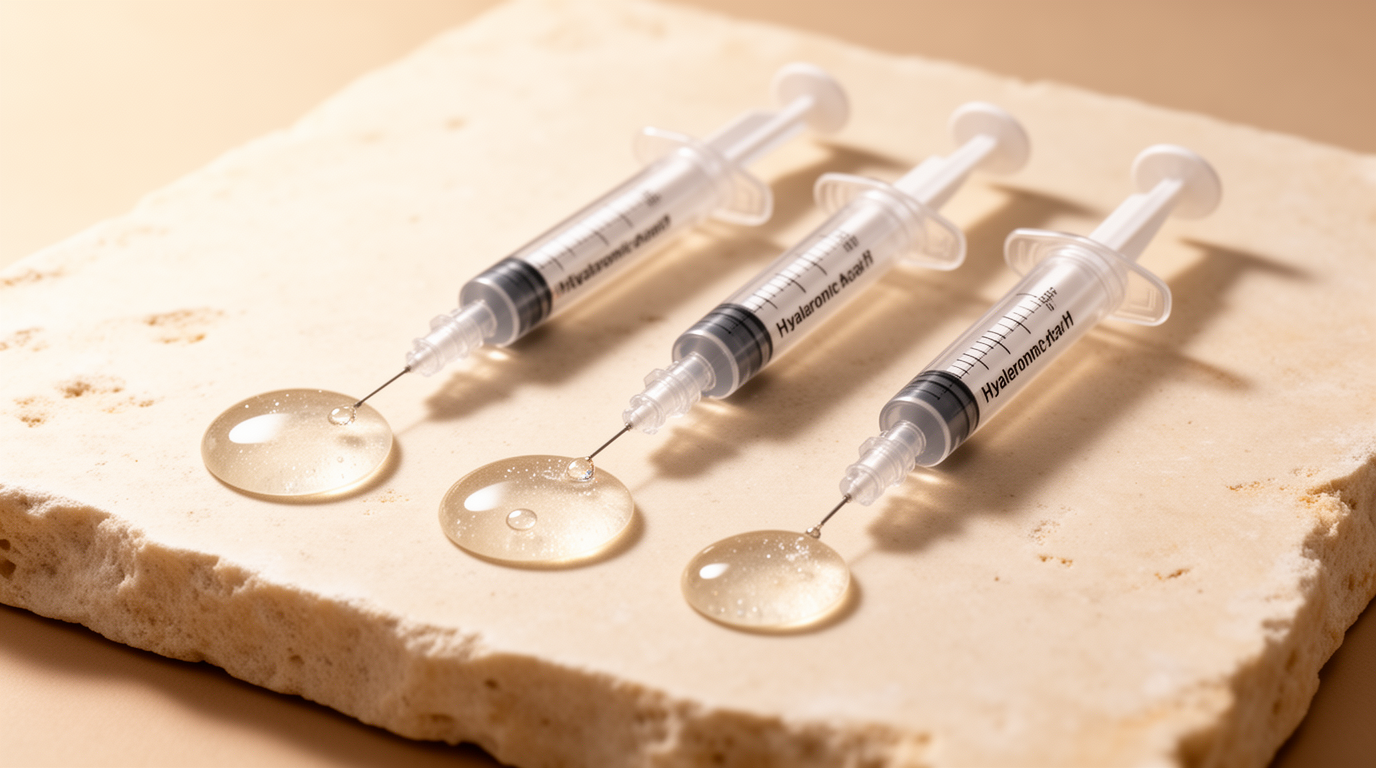
In aesthetic medicine, fillers can be made from different materials. Hyaluronic acid, or HA, is the category many people are most familiar with. HA is a naturally occurring sugar found in our tissues, and HA fillers are temporary gels designed to create volume, contour, or smoothing.
Other filler materials include calcium hydroxylapatite, poly-L-lactic acid, and polymethylmethacrylate. Some of these act more as biostimulatory or longer-lasting materials rather than behaving like a classic soft HA gel. They are not interchangeable, and the appropriate material depends on the treatment area, the goal, and the specific product's approved use.
For delicate areas such as the lips, HA fillers are commonly chosen because there are options that can be soft, flexible, moldable, and appropriate for tissue that moves constantly.
Even HA fillers are not all the same
This is where filler selection gets more interesting. Two syringes can both contain hyaluronic acid and still behave very differently once they are placed in tissue.
Some HA gels are softer and more flexible. Some are firmer and better at resisting compression. Some spread and integrate very smoothly. Others hold shape and projection more strongly. Some attract more water than others. These differences come from how the HA is formulated and cross-linked, as well as the gel's elasticity, viscosity, cohesivity, and other physical properties.
What is G′ — or “G-prime”?
One term you may hear injectors use is G′, pronounced “G-prime.” G′ is a rheology measurement that describes the elastic behavior of a gel — essentially, how strongly it resists being deformed and how much it tends to spring back toward its original shape.
In very simplified terms, a higher-G′ filler tends to provide more firmness, support, or projection, while a lower-G′ filler tends to behave more softly and may move more naturally in areas where flexibility is important.
But G′ is not a score where higher automatically means better. It is one characteristic among several. A beautiful result depends on matching the gel's behavior to the anatomy and the goal. Cohesivity, viscosity, water uptake, how the gel integrates into tissue, injection depth, technique, and the patient's own anatomy all matter too.
Soft and flexible filler
For an area that moves constantly — especially the lips or fine lines around the mouth — I often want a gel that can move with the tissue rather than feeling stiff. Softer fillers with lower-to-moderate elasticity can be useful when the goal is subtle smoothing, natural movement, or gentle volume.
That does not mean every lip should receive the softest possible filler. If someone wants more projection or shape, we may want a gel with a little more support while still respecting how mobile the lips are.
More supportive filler
In areas where the goal is contour, projection, or structural support, a firmer gel may make more sense. These products tend to resist deformation better and can be useful when we want the filler to maintain shape rather than simply blend softly into a very mobile area.
The important point is that we are not trying to make every part of the face feel the same. The cheek, chin, jawline, nasolabial fold, under-eye area, and lips all have different anatomy and different mechanical demands.
Sometimes the right answer is not more filler
Product selection matters, but so does knowing when filler is not the right tool. A line may be caused by muscle movement rather than volume loss. Skin texture may respond better to resurfacing or collagen-stimulating treatments. A heavy area may not benefit from adding more volume. And sometimes the most natural result comes from treating less.
Why I don't choose filler by popularity
It is easy to see a filler trending online and assume that must be the one you need. But the name on the syringe matters less than whether the product's properties make sense for your anatomy and your goal.
When I am thinking through filler, I am asking questions like: Do we need softness or structure? Movement or projection? Smoothing or contour? How thick is the tissue? How much does this area move? What is the safest plane and amount? What does this person's face actually need?
The simplest way to think about it
Filler is not one-size-fits-all. A soft gel, a flexible gel, and a firmer structural gel may all be excellent products — just for different jobs.
The goal is not to pick the “strongest” filler or the one everyone is talking about. The goal is to choose the material, texture, amount, and technique that fit the area being treated and the result you are actually trying to create.
And as always, filler is a medical procedure. Product choice is only one part of safety. Facial anatomy, sterile technique, appropriate indications, conservative dosing, and the ability to recognize and manage complications matter just as much as what is inside the syringe.
Sources
FDA — Dermal Fillers (Soft Tissue Fillers) https://www.fda.gov/medical-devices/aesthetic-cosmetic-devices/dermal-fillers-soft-tissue-fillers


Comments